“You’ve got a heel spur.”
 That’s usually all it takes. One look at an X-ray, one sentence from a doctor, and a patient finally has an explanation for months of pain, and something to blame it on.
There’s just one problem. It’s often the wrong thing to blame.
We see this play out almost every week at Adelaide Heel Pain Clinic. Someone gets imaging after weeks or months of heel pain, the report mentions a spur, and everything clicks into place in their mind. That must be the reason it hurts. Deal with the spur, and surely the pain goes with it.
Except that’s not really how heel spurs work. And believing it can send you down the wrong treatment path entirely — one that’s been sending people astray for decades.
What a heel spur actually is
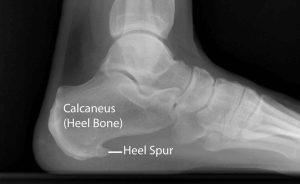
A heel spur is a small calcium deposit that forms on the underside of the heel bone, usually where the plantar fascia attaches — the thick band of tissue running along the bottom of your foot. Rather than a sharp thorn digging into the foot, picture a smooth, bony ridge that builds up gradually over years, as the plantar fascia repeatedly pulls and tugs at the front of the heel bone.
It doesn’t appear overnight, and it isn’t a sign that something suddenly went wrong. It’s closer to a scar your bone has slowly built up in response to years of tension at that exact spot.
The part most people don’t expect
Heel spurs are extremely common, and most of them don’t hurt at all.
X-rays of the general population regularly turn up heel spurs in people who’ve never had a day of heel pain in their life. At the same time, plenty of people in genuine agony get scanned and find no spur there whatsoever.
If spurs caused pain by themselves, neither of those groups would exist. But they do, and in large numbers. This isn’t a new observation, either. Decades ago, when heel pain was more routinely treated by surgically removing the spur itself, the results were consistently disappointing. Patients had the bony growth taken out and the pain often stuck around regardless, which is exactly what led researchers to look more closely at what was actually happening at that site. What they found was that the spur is very often just along for the ride, not the thing actually causing the trouble.
So if it isn’t the spur, what is?
The real source of the pain
In most cases, what people feel as “spur pain” is actually coming from the plantar fascia and the soft tissue around it, at the exact spot where the spur happens to sit. The tissue there becomes scarred and irritated from repeated strain, and that irritation, not the bone underneath it, is what you feel with every step.
That overlap is exactly why heel spurs and plantar fasciitis get confused for one another so often. They tend to show up in the same place, in the same people, for the same underlying reason: repetitive tension on that tissue. The spur is a sign that this tension has been building there over time. It’s rarely the source of what you actually feel.
That’s not a small distinction. It changes how the problem should be treated, and it’s the reason “heel spurs” has been called a misleading diagnosis for over thirty years now.
Why the mix-up matters
If you believe the spur itself is the problem, it’s natural to assume the fix is getting rid of it, whether that means surgery or just fixating on the bony growth visible on the scan.
But because the spur usually isn’t the real source of pain, removing it doesn’t always fix anything. We meet patients who’ve already been told their spur is the issue and are still stuck with the same heel pain, because the actual driver — the strain on the plantar fascia — was never properly addressed. And left untreated, this isn’t a problem that reliably resolves on its own. Research following people with this kind of heel pain found that half were still dealing with it five years later, and nearly half were still affected after ten.
It’s one of the more common frustrations we hear from new patients: “I already dealt with the spur, so why does it still hurt?”
The encouraging part is that once the actual cause is treated properly, most people get real, lasting relief. Removal is rarely part of the picture.
How we actually find the cause
Every treatment plan starts with working out exactly what’s driving the strain at your heel, not just confirming that a spur is there. That means a proper assessment of how you walk and stand, using computerised gait analysis to see precisely where the excess load is landing through your stride, rather than guessing from a static exam. Where it’s useful, we also use diagnostic ultrasound to look directly at the plantar fascia itself and see how irritated or thickened it actually is, and AxIT muscle strength testing to check whether a weakness somewhere in the chain, often through the calf, is quietly overloading the heel with every step.
This is the part that gets skipped in a lot of heel pain treatment. Two people can present with what looks like the same problem and need completely different fixes, and without this level of assessment, you’re really just guessing.
The treatments we use, and why
Once we know what’s actually driving your case, treatment is built around that specific cause rather than pulled from a generic checklist.
Custom orthotics are the right fit for a large number of heel spur patients, because they address the mechanics directly responsible for the tension pulling at the heel bone. Rather than just cushioning the foot, a properly made orthotic changes how load moves through it with every step, taking pressure off the exact area where the fascia is strained and letting that tissue actually settle and repair. Ours are engineered from a full assessment of your foot and gait, then made onsite rather than sent off to an external lab, which means much faster turnaround and the ability to fine-tune the device as your foot responds to treatment, rather than being stuck with something fixed that either works or doesn’t.
Shockwave therapy, in both standard radial and more targeted focused forms, is one of the most effective tools we have for tissue that’s become chronically irritated rather than acutely injured, which describes most long-standing heel spur pain. It works by stimulating the body’s own healing response at a cellular level, essentially prompting tissue that’s stalled in its repair process to start healing again.
Low level cold laser therapy is often used alongside this to help settle inflammation directly at the site, particularly useful in the earlier, more acute stages when the tissue is especially reactive.
Foot mobilisation therapy addresses joint restriction and stiffness through the foot and ankle that can be quietly contributing to the strain pattern, restoring movement that’s often been lost without anyone realising it.
Rehabilitation and strengthening programs finish the job. Calming the pain is only part of the picture; rebuilding the strength and flexibility that let the problem develop in the first place is what actually keeps it from coming back.
For select cases where these approaches haven’t fully resolved things, dry needling and prolotherapy offer further options aimed at genuinely stubborn or long-standing tissue irritation.
None of this involves chasing the spur itself. It’s about calming and correcting the tissue that’s actually inflamed, and dealing with the biomechanics behind it, which tends to respond well once it’s treated properly and specifically, rather than generically.
The takeaway
Seeing the word “spur” on a scan can feel like a diagnosis in itself. Really, it’s more of a footnote — something your body built up over years of loading that particular spot. The real story, and the real path to relief, is in the soft tissue around it, and in whatever’s been putting it under that much strain to begin with.
If you’ve been told you have a heel spur and assumed that explains everything, it’s worth getting a fuller picture of what’s actually going on, from a clinic built specifically around treating heel pain properly, with the tools to match.
Ready to find out what’s really behind your heel pain? Book a Gap Free Assessment with Adelaide Heel Pain Clinic and let’s get to the actual source — not just the shadow on the scan.
